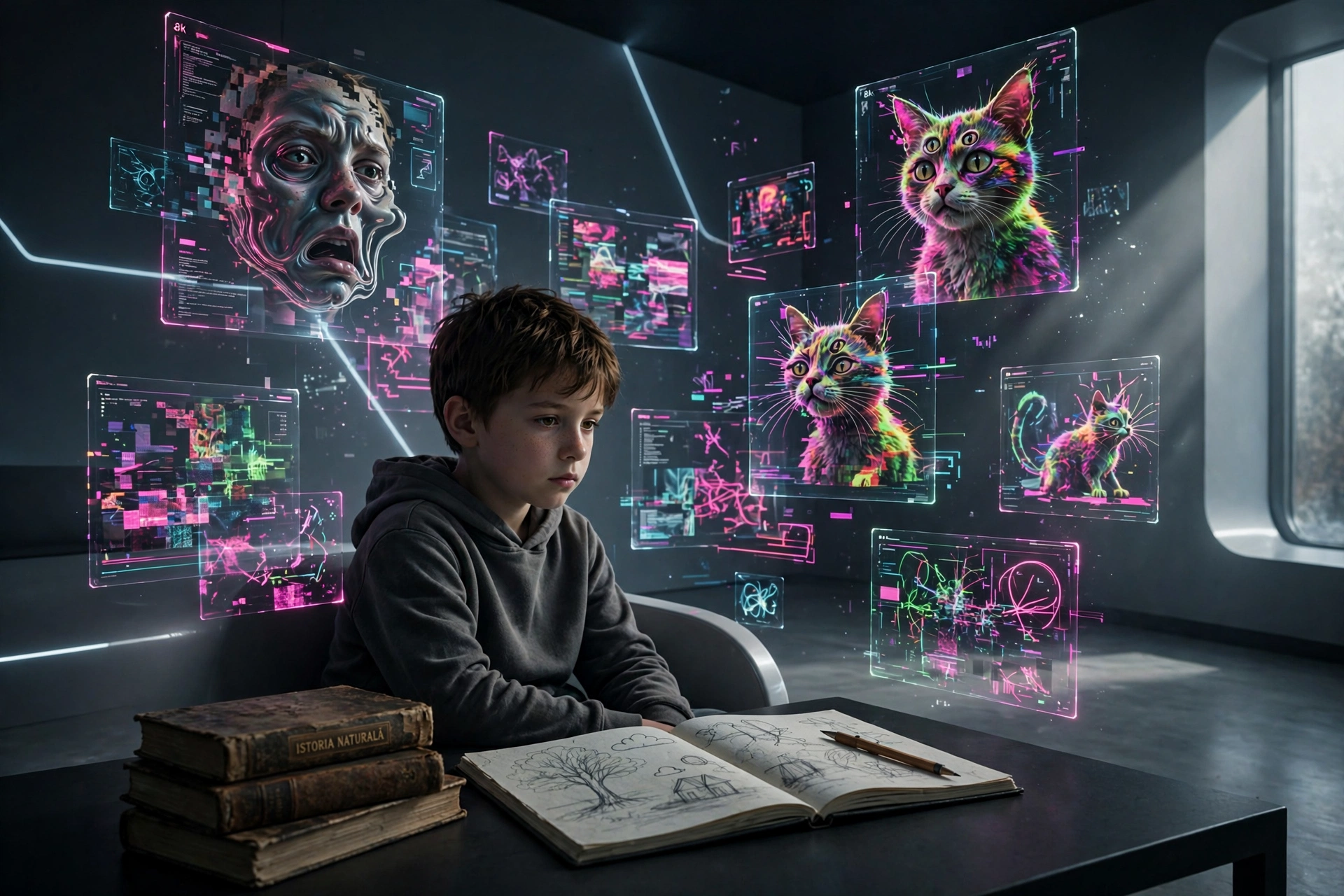
The “AI Slop” Generation: How Synthetic Content Affects Children’s Development
In today’s digital era, children and young people are no longer just consumers of human-created content; they are facing a massive wave of automatically generated artificial intelligence material, a phenomenon known as “AI Slop”. The term describes low-quality synthetic content—repetitive videos, altered images, assembly-line generated stories, and virtual avatars—created exclusively to farm views and maximize ad revenue.
While at first glance this material may seem harmless or merely silly, its impact on children’s cognitive, psychological, and educational development is becoming a central topic of debate among researchers, parents, and educators.
What Is “AI Slop” and Why Is It Flooding Platforms?
The concept of “AI Slop” is the digital equivalent of low-quality fast food: it is cheap to produce, rapidly processed in huge quantities, and designed to capture attention without offering any nutritional or educational value. On platforms like YouTube, TikTok, and social media networks, algorithms prioritize bright colors, chaotic movements, and hyper-stimulating, automatically generated narratives.
For creators, automation means mass production without effort. For children, however, this uninterrupted stream of synthetic content creates a dependency on rapid visual stimulation.
Impact on Cognitive Development and Attention Span
One of the main concerns surrounding early exposure to AI Slop content is the shrinking of attention spans and the decline in concentration abilities. Children exposed to fast-paced sequences lacking coherent narrative logic may face difficulties in:
- Reading and deep processing: Going through a long text or following a classic story becomes boring compared to the fast pace of synthetic videos.
- Critical thinking: Because AI Slop content requires no interpretive effort, children become passive receivers of information.
- Language development: Auto-generated stories often use simplified, repetitive, or contextually incorrect language.
Distortion of Reality and the Loss of Real Creativity
Another major risk is the difficulty young children have in distinguishing reality from visual manipulation. When AI-generated images and characters are ubiquitous, the line between fiction, misinformation, and reality becomes extremely blurred.
Furthermore, children’s creativity is nurtured through unstructured play, hand-drawing, and real-world interaction. Replacing these activities with the passive consumption of synthetic images risks suppressing genuine imagination by providing ready-made solutions produced by algorithms.
How Can Parents and Educators Intervene?
Managing the AI Slop phenomenon does not mean a total ban on technology, but rather promoting a healthy digital education:
- Content filtering: Selecting platforms and channels that offer human-created, verified, age-appropriate content.
- Encouraging critical thinking: Having open discussions with children about how videos are made and how to spot computer-generated material.
- Balancing with offline activities: Encouraging traditional reading, outdoor play, and hands-on artistic creation.
In an increasingly automated world, protecting children’s natural development and cultivating their attention remains an essential priority for the future.
Reference Sources:
- The Irish Times – ‘Stop Hiring Humans,’ declares the billboard. Inside the strange culture of San Francisco’s AI boom (Analysis on AI culture and automation in public spaces).
- Future of Life Institute – The Pro-Human Assembly 2026 & The Prohuman AI Declaration (Safeguarding human experience, personal agency, and child development in the AI era).
- NPR / CNBC / Cybernews – Reports and analyses regarding autonomous agents and synthetic content integration.